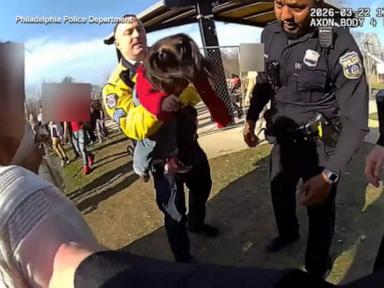
The survival rate of a pediatric choking incident decreases non-linearly with every thirty-second delay in airway clearances. While viral media reports frame successful police interventions in these scenarios as spontaneous acts of heroism, a systemic evaluation reveals that these outcomes are the direct result of rapid neurological triage, spatial optimization, and the execution of specific mechanical leverage.
By analyzing the viral footage of a law enforcement officer rescuing a choking toddler, we can isolate the critical variables that dictate life-or-death outcomes in acute pediatric asphyxiation. The standard public understanding of these events relies on emotional narratives. The operational reality, however, depends entirely on minimizing the Time-to-Patency (TtP) metric through a predictable sequence of physical maneuvers.
The Kinematics of Foreign Body Airway Obstruction
To understand why immediate intervention is mandatory, one must look at the physiological differences between pediatric and adult airways. A toddler’s trachea is narrow, highly compliant, and funnel-shaped, with the narrowest point located at the cricoid cartilage. When a foreign object enters this space, it creates a mechanical blockage that initiates a rapid cascade of hypoxemia, hypercapnia, and subsequent respiratory failure.
[Foreign Object Lodged] -> [Complete Laryngeal Spasm] -> [Intratoracic Pressure Drop] -> [Hypoxic Arrest]
The primary bottleneck in these incidents is the rapid depletion of the child's functional residual capacity (FRC)—the volume of air remaining in the lungs after a normal expiration. Because toddlers have a high metabolic rate and low FRC relative to adults, their arterial oxygen saturation ($SaO_2$) plummets dangerously within 60 to 90 seconds of a complete obstruction. This leaves no margin for error or logistical delay.
The Three Pillars of Tactical Triage
When a first responder encounters a choking child, their effectiveness relies on three distinct operational phases.
1. Neurological Assessment and Immediate Classification
The officer must instantly differentiate between a partial and a complete airway obstruction. A partial obstruction allows for some gas exchange; the child may cough loudly or produce stridor (a high-pitched wheezing sound). In contrast, a complete obstruction is silent. The absence of vocalization, accompanied by ineffective, paradoxical chest movements (see-saw breathing) and rapid peripheral cyanosis, serves as the definitive trigger for immediate physical intervention.
2. Spatial Reconfiguration and Stabilization
The responder must secure physical control of the patient to maximize mechanical efficiency. This requires altering the center of gravity. In the reference event, the officer immediately transitions the toddler from an upright, unstable position to a prone, head-down angle across their forearm. This utilizes gravity to assist in object displacement and stabilizes the child's axial skeleton, preventing cervical spine injury during the high-impact maneuvers that follow.
3. The Kinetic Energy Transfer Function
The clearance of a foreign object requires generating sufficient intrapulmonary pressure to force the object outward against friction and laryngeal spasms. The mathematics of this mechanism rely on two primary actions:
- Subdiaphragmatic Upward Thrusts (Heimlich Maneuver): For children over one year of age, upward thrusts compress the abdomen, elevating the diaphragm abruptly. This decreases intrathoracic volume and creates an artificial cough, spiking the internal airway pressure ($P_{aw}$) above the threshold holding the object in place.
- Back Blows: For infants or smaller toddlers, alternating back blows deliver a distinct kinetic shock wave through the thoracic cage. This energy transfers directly to the columns of air behind the obstruction, dislodging the object's surface seal against the tracheal wall.
Operational Bottlenecks and Failure Modes in Emergency Response
The success of the officer in this case highlights the glaring vulnerabilities found in standard citizen-led responses. The general public faces significant cognitive friction when managing acute medical crises, leading to predictable failure modes.
The Hysteresis of Panic
Untrained bystanders experience a massive sympathetic nervous system surge, resulting in tachycardia, tunnel vision, and a loss of fine motor skills. This psychological state causes a delay in action, often wasting the critical 60-second FRC window. First responders override this through overlearned motor programs—muscle memory developed through repetitive, scenario-based training that converts deliberate cognitive tasks into automatic physical responses.
The Blind Sweep Error
A common and dangerous error made by untrained individuals is the insertion of fingers into the child's mouth without visualizing the object. In a panicked attempt to remove the obstruction, this action frequently acts as a mechanical piston, pushing the foreign object deeper into the larynx or converting a partial obstruction into a catastrophic, complete blockage.
Inadequate Force Application
Bystanders often fail to generate the required intrathoracic pressure due to a fear of injuring the child. While fractured ribs or internal bruising are known risks of aggressive airway clearance maneuvers, they represent acceptable morbidity when compared to the absolute mortality of an unresolved airway obstruction. The trained professional applies calculated, forceful impacts designed to maximize pressure thresholds rather than prioritizing superficial comfort.
The Systemic Architecture of Public Safety Interventions
The rescue of a choking toddler by a patrolling officer is not an isolated event; it is the manifestation of a broader public safety architecture. For an infrastructure to consistently produce these positive outcomes, it must optimize three specific vectors.
                  +-----------------------------------+
                  |  Total Time-to-Patency (TtP)      |
                  +-----------------------------------+
                                    |
       +----------------------------+----------------------------+
       |                            |                            |
+------v------+              +------v------+              +------v------+
| Geolocation |              | Dispatch    |              | Decentral-  |
| Latency     |              | Efficiency  |              | ized Skills |
+-------------+              +-------------+              +-------------+
Geolocation Latency
The physical distance between a mobile emergency unit and the incident point must be minimized. Law enforcement deployment models that emphasize proactive, decentralized neighborhood patrolling naturally position officers closer to residential crises than centralized emergency medical services (EMS) stations can manage.
Dispatch Efficiency
The integration of emergency communication systems must allow for the simultaneous routing of police, fire, and medical assets. When a citizen dials emergency services, the internal processing time must match the critical thresholds of the physiological clock. Every second spent validating address details or repeating descriptions directly degrades the patient’s survival probability.
Decentralized Medical Competency
Expanding basic life support (BLS) training across all tiers of municipal employment—from traffic enforcement to sanitation workers—creates a dense network of potential intervention vectors. When high-acuity medical training is restricted solely to dedicated paramedics, the system creates a single point of failure based entirely on transit times.
Systemic Limitations and Unresolved Risks
Despite the clear success demonstrated in this specific incident, tactical interventions of this nature possess structural limitations that prevent them from being a universal solution to pediatric emergencies.
The primary risk is the probability of a secondary airway collapse. Even after the successful expulsion of a foreign object, localized edema (swelling) caused by the trauma of the object or the force of the maneuvers can trigger a secondary obstruction. Furthermore, if the object was partially aspirated rather than fully expelled, it may migrate into the mainstem bronchi, leading to atelectasis (lung collapse) or insidious localized infections.
Consequently, a successful field extraction does not conclude the medical event. Immediate transport to a tertiary care facility remains mandatory for definitive endoscopic evaluation and continuous respiratory monitoring.
Optimization Protocols for Public and Institutional Readiness
To scale the success of this individual officer's intervention into a repeatable societal outcome, municipalities and corporate entities must transition from reactive celebration to proactive structural design.
The immediate imperative is the mandatory implementation of pediatric BLS and foreign body airway obstruction clearance protocols in all high-density civilian environments, specifically childcare facilities, schools, and public dining spaces. These programs must move away from passive video viewing and focus instead on high-fidelity simulators that measure the exact Newton-meters of force required to clear a blocked airway.
Simultaneously, municipal emergency frameworks must deploy automated dispatch algorithms that leverage real-time GPS tracking of all city assets. If a police unit, code enforcement vehicle, or park ranger equipped with BLS training is closer to an active choking call than an ambulance, the system must automatically route that asset to the scene. Minimizing Time-to-Patency requires removing institutional boundaries and treating every municipal vehicle as a mobile, high-velocity resuscitation platform.