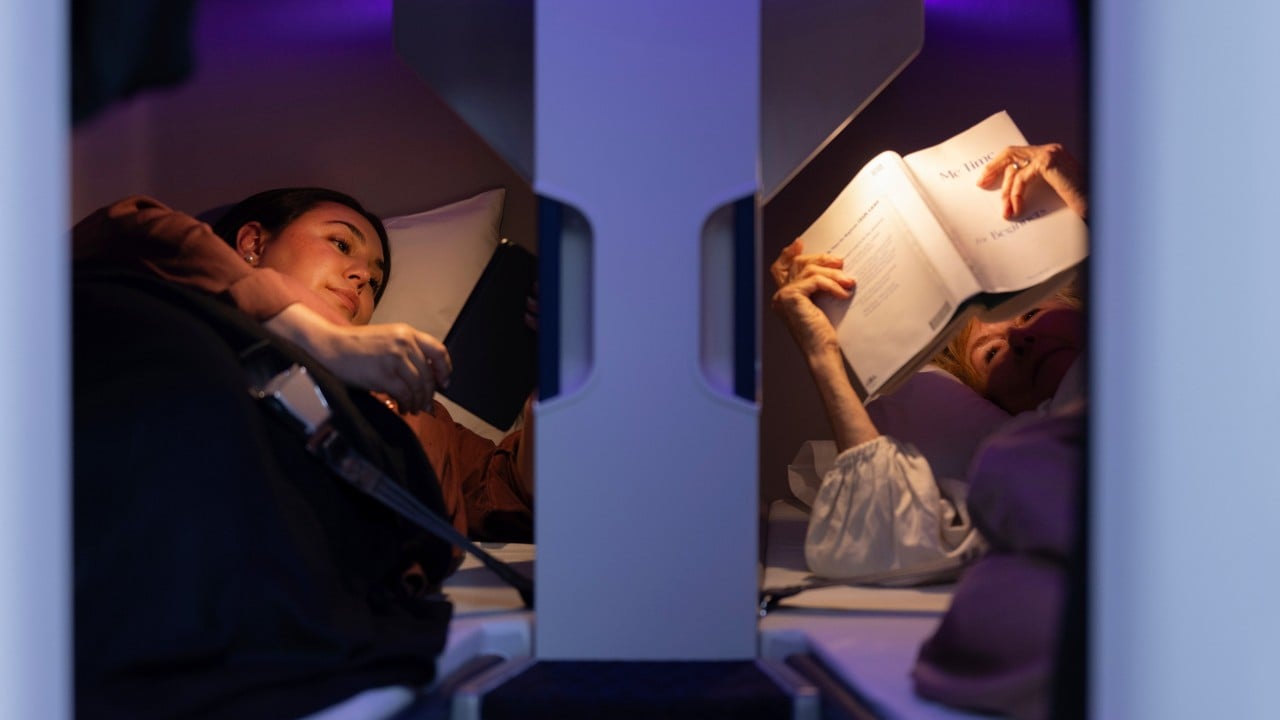
You know the feeling. You're fourteen hours into a flight from Auckland to New York, wedged between a snoring stranger and a window that offers nothing but dark clouds. Your neck is at a 45-degree angle. Your legs are pulsing. You’d pay almost anything for just two hours of horizontal sleep. Air New Zealand finally listened to that collective scream from the back of the plane. They’re launching the Skynest, a world-first sleep pod concept that actually lets economy passengers lie flat. It’s a massive shift in how airlines treat the people who don’t have five figures to drop on a business class suite.
This isn't just another flashy gimmick or a slightly better headrest. We're talking about actual bunk beds in the sky. For years, the "mile-high sleep club" was a privilege reserved for the elite or the incredibly lucky. Air New Zealand is breaking that wall. They’ve spent five years and more than 170,000 design hours to figure out how to cram beds into a Boeing 787-9 Dreamliner without making the cabin feel like a submarine. It’s ambitious. It’s risky. Honestly, it’s about time.
Why the Skynest Matters for Long Haul Travel
The physics of human sleep and the economics of aviation have always been at war. Airlines want more seats; humans want more space. Usually, the airlines win. But on ultra-long-haul routes—the ones pushing 15 to 18 hours—the lack of sleep becomes a genuine health and safety issue. Deep vein thrombosis, extreme fatigue, and severe jet lag aren't just inconveniences. They ruin trips.
Air New Zealand’s solution is a six-pod sleep zone. These pods aren't permanent seats. You don't stay there for the whole flight. Instead, you book a session. Think of it like a spa appointment, but instead of a massage, you get a flat mattress and a pillow. It’s a shared resource that maximizes the limited real estate on a plane. By moving the sleep experience away from the seat, the airline keeps the ticket prices relatively accessible while offering a premium "add-on" that actually works.
How the Sleep Pods Actually Work
The Skynest is located between the Premium Economy and Economy cabins. It’s a stack of six bunks, arranged in two rows of three. Each pod is about 200 centimeters long and 58 centimeters wide. That’s enough for most people to stretch out fully. You get a full-size pillow, sheets, a blanket, and even earplugs.
- The Session Length: You get four hours. Research shows that a typical sleep cycle is around 90 minutes. A four-hour block gives you two full cycles plus some time to settle in and wake up.
- The Transition: Between sessions, the crew has a 30-minute transition period. They change the bedding and sanitize the area. It’s a tight turnaround, but it ensures every passenger gets a fresh space.
- Amenities: Each pod has a reading light, a USB outlet for your devices, and a ventilation outlet. There's even a separate seatbelt so you can stay tucked in even if the pilot hits a bit of chop.
Critics might argue that four hours isn't enough. I disagree. If you've ever tried to sleep upright in seat 44E, you know that four hours of flat sleep is worth ten hours of nodding off and waking up every time the person next to you goes to the bathroom. It's the difference between landing as a zombie and landing as a functioning human being.
The Cost of a Nap in the Clouds
Air New Zealand hasn't been shy about the pricing, though it's subject to change based on demand. Current estimates put a four-hour session somewhere between $400 and $600 NZD. That’s roughly $250 to $380 USD.
Is it cheap? No. Is it worth it? Probably. If you're flying for 17 hours, paying an extra $300 to ensure you arrive ready to hit the ground running is a logical investment for many business travelers and vacationers with limited time. It’s certainly cheaper than upgrading to Business Premier, which can cost five times the price of an economy ticket.
The airline limits each passenger to one session per flight. This prevents one person from hogging a pod for the entire trip and ensures that more people get a crack at some decent rest. It’s a democratic approach to luxury.
Design Challenges and Engineering Feats
Building something like this isn't as simple as tossing some bunk beds in the back. Everything on a plane has to be certified by aviation authorities. The Skynest had to pass rigorous crash testing and fire safety regulations. Air New Zealand worked closely with regulators to prove that passengers could be safely evacuated from the pods in an emergency.
The weight was another huge factor. Every kilogram added to a plane means more fuel burned. The materials used in the Skynest are lightweight but incredibly durable. The airline also had to account for the loss of seat revenue. They had to remove several economy seats to make room for the pods. The math only works if enough people are willing to pay the premium for the sleep sessions.
What This Means for the Future of Flying
Other airlines are watching this very closely. If the Skynest is a hit, expect to see similar concepts from carriers like Qantas, Singapore Airlines, and Delta. We are seeing a shift where the "seat" is no longer the only product an airline sells. They’re selling "time" and "wellness."
The "Lufthansa Allegris" project and other premium economy overhauls show that the middle of the plane is the new battleground. Passengers are tired of the race to the bottom. They’re willing to pay for specific comforts, provided they aren't forced into a $6,000 ticket. Air New Zealand found the sweet spot. They’re treating economy passengers like humans instead of cargo.
Realities of the Shared Sleep Space
Let's be real for a second. The idea of sleeping in a bunk bed just a few feet away from five other strangers might sound a bit like a high-end hostel. There will be noise. Even with "sleep-inducing" lighting and cooling, you’re still on a plane. If the person in the pod above you is a heavy breather, you're going to hear it.
The crew also has the unenviable task of being "bed wardens." They have to wake people up at the end of their sessions. Imagine being in a deep sleep after ten hours of travel and having a flight attendant gently tell you it’s time to go back to your cramped seat. It’s going to be a jarring transition. But again, it beats the alternative of never lying down at all.
How to Book Your Spot
If you’re planning a trip on one of Air New Zealand’s ultra-long-haul routes, specifically the Auckland-New York or Auckland-Chicago legs, you need to plan ahead.
- Book Early: These pods will sell out fast. There are only six pods per flight, and with hundreds of passengers on a Dreamliner, the math is not in your favor.
- Check the Aircraft: Make sure your flight is operated by the specific 787-9 configuration that features the Skynest. Not every plane in the fleet has been retrofitted yet.
- Time Your Session: If you’re flying East, try to get a session that aligns with the nighttime at your destination. If you’re flying West, use the pod to stay awake longer or catch a nap during the "mid-flight slump."
- Pack Light: You can't bring your carry-on into the pod. Bring a small pouch with just your phone, headphones, and maybe a sleep mask.
Air New Zealand changed the game once before with the Skycouch—where you could book a whole row of seats to lie down. The Skynest is the evolution of that idea. It’s more private, more comfortable, and a much better use of space. It’s a bold move that proves you don't need a corporate credit card to get a decent night's sleep over the Pacific.
Stop settling for a stiff neck and a miserable arrival. If you're on a long-haul flight, check the booking options for the Skynest. Even if you only get four hours, your body will thank you when you land. The days of economy class being a total endurance test might finally be coming to an end. Keep an eye on your booking portal as your flight date approaches; last-minute openings happen, and snagging one might be the best travel decision you ever make.


