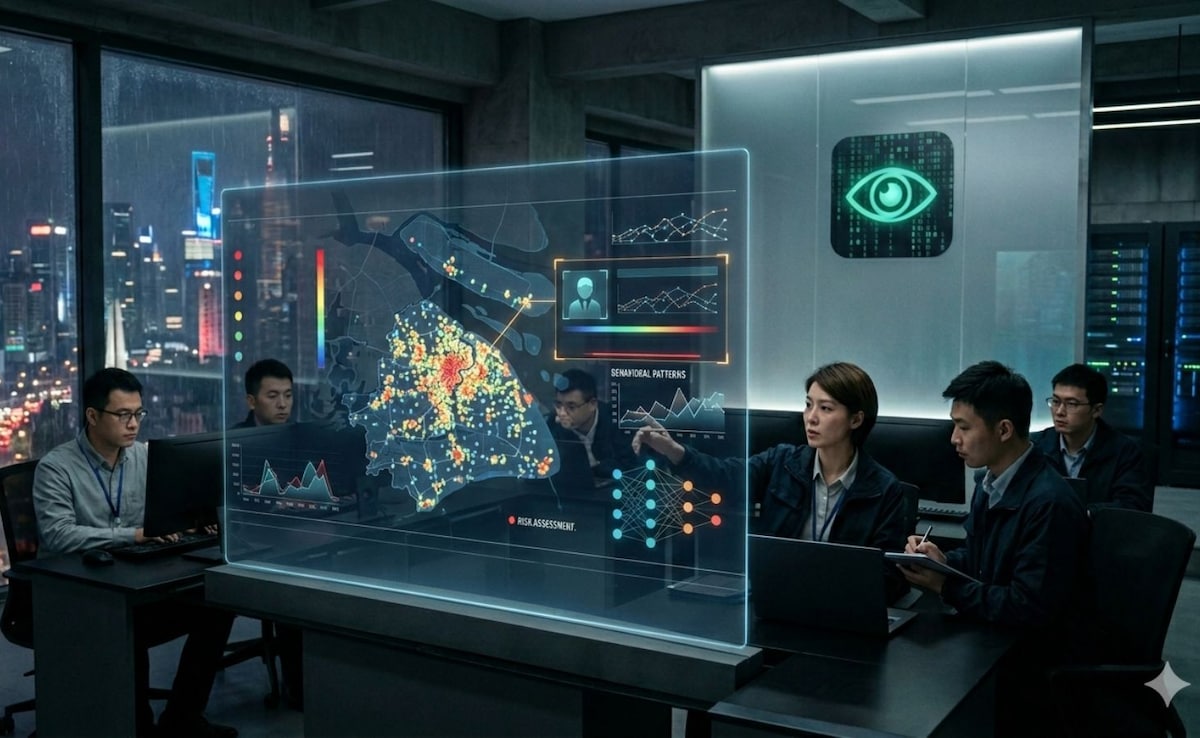
Western media is having another collective panic attack over Chinese surveillance. The catalyst this time is a series of breathless reports about defense contractors and state-backed firms developing artificial intelligence meant to predict future protestors before they even lace up their shoes. The narrative is always the same: an all-seeing, algorithmic panopticon that crushes dissent with flawless, predictive precision.
It is a terrifying story. It is also an absolute lie. Don't miss our earlier article on this related article.
The lazy consensus among tech pundits and human rights watchdogs is that this technology actually works. We are told that big data, mixed with facial recognition and crowd-behavior analytics, has cracked the code on human intent.
I have spent over a decade auditing algorithmic risk and watching enterprises sink millions into predictive analytics. Here is the cold reality: these systems are not terrifying because they are omniscient. They are terrifying because they are fundamentally broken, wildly inaccurate, and serve as an expensive security theater for paranoid regimes and gullible bureaucrats. To read more about the context here, MIT Technology Review offers an excellent summary.
China isn't building Minority Report. They are building a multi-billion-dollar confirmation bias engine.
The Mathematics of the False Positive Trap
To understand why predictive policing and protest forecasting fail, you have to look past the marketing brochures and understand basic probability. The engineers selling these platforms deliberately ignore a foundational statistical reality: the Base Rate Fallacy.
Protests, riots, and mass dissents are mathematically rare events. In a city of 10 million people, perhaps a few hundred will attempt to initiate a disruptive public demonstration on any given day.
Let us look at the math using a standard diagnostic framework. Imagine a scenario where a state-of-the-art predictive AI boasts an incredible 99% accuracy rate. That sounds infallible. But when applied to rare events, the system implodes.
Suppose we have a population of 100,000 citizens. Out of these, exactly 100 are actual, high-risk agitators planning an imminent disruption.
- The True Positives: The 99% accurate AI correctly identifies 99 of those 100 agitators.
- The False Positives: The AI looks at the 99,900 innocent citizens. Because it has a 1% error rate (100% minus 99%), it incorrectly flags 1% of them. That equals 999 innocent people labeled as impending threats.
When the system sounds the alarm on a suspected protestor, the probability that the flagged individual is actually a threat is calculated by dividing the true positives by the total number of positive flags:
$$P(\text{Threat} \mid \text{Flag}) = \frac{99}{99 + 999} \approx 9.02%$$
Even with a flawless 99% accuracy rate, the system is wrong more than 90% of the time. For every genuine dissenter flagged, the state arrests, detains, or interrogates nine loyal, completely innocent citizens.
This is not a software bug that can be patched in the next version. It is an immutable mathematical property of trying to predict rare human behaviors. When applied at the scale of a province or a country, the sheer volume of false positives creates massive operational friction. It chokes law enforcement with useless leads, wastes resource budgets, and actively radicalizes the innocent populace subjected to unwarranted harassment.
Garbage Data In, Paranoia Out
Protest prediction algorithms rely on data aggregation from multiple vectors: social media scraping, financial transactions, travel patterns, and historical arrest records.
The flaw here is glaringly obvious to anyone who has ever trained a neural network. The training data is hopelessly corrupted by historical human bias.
If a security apparatus historically over-policed a specific neighborhood, university campus, or ethnic demographic, the historical data will reflect a high concentration of "subversive" activity in those areas. The AI does not discover a hidden pattern of subversion. It simply uncovers the historical patterns of the police force that trained it.
The algorithm then instructs authorities to deploy more surveillance assets to those exact locations. More surveillance leads to more interventions, which generates more data confirming the original bias.
It is a closed-loop feedback system. It turns institutional paranoia into a self-fulfilling prophecy.
Furthermore, human intent is non-linear. A citizen buying a megaphone, printing twenty flyers, and searching for "labor laws" on a local search engine might look exactly like a protest organizer to a pattern-matching algorithm. In reality, they could just be a frustrated middle-manager prepping a presentation for an internal corporate dispute.
AI cannot parse irony, desperation, or theater. It views human behavior through a rigid, literal lens, transforming mundane friction into existential threats to the state.
The Real Value of Predictive AI is Procurement, Not Security
If these platforms are so mathematically flawed, why are defense contractors winning massive contracts to build them?
Follow the money.
The tech sector operates on a hype cycle that is identical whether you are in Silicon Valley, Tel Aviv, or Shenzhen. Bureaucrats and military officials suffer from a profound fear of missing out. No government minister wants to admit to their superiors that they are relying on old-school human intelligence while their geopolitical rivals are buying "spatial AI sentiment engines."
These tools are bought for two reasons:
1. Corporate Grift and Budget Justification
Tech vendors sell the illusion of certainty to anxious autocrats. By bundling basic database querying and facial recognition into a shiny dashboard labeled "Predictive Crisis Management," contractors can charge a 10x premium. It justifies inflated security budgets and gives officials a convenient scapegoat when things go wrong ("The algorithm didn't flag them").
2. Intimidation by Proxy
The efficacy of the tool is irrelevant if the population believes it works. The public announcement that a state has deployed an AI that can read your mind and predict your future docility is a psychological operation. It aims to induce learned helplessness. If you believe the state knows you are going to protest before you even leave your house, you stay home.
The threat is not the code. The threat is the marketing.
Dismantling the Consensus: Your Questions, Corrected
The mainstream discourse surrounding this tech is built on fundamentally flawed premises. Let us address the questions people are actually asking, and inject some uncomfortable truth.
Can AI accurately predict a riot before it happens?
No. AI can identify historical correlations, not causation. It can tell you that riots often happen when inflation hits a certain percentage, temperatures exceed 32°C, and a specific keyword spikes on local forums. But it cannot predict the chaotic spark—the specific traffic stop, the viral video, or the sudden political assassination—that transforms ambient frustration into an active riot. It is weather forecasting without a fluid dynamics model.
How do we regulate predictive surveillance to make it ethical?
You don't. This question assumes that a more ethical, unbiased version of predictive surveillance is technically possible. It isn't. You cannot regulate away the Base Rate Fallacy. Trying to make predictive policing "fair" is like trying to build a perpetual motion machine out of sustainable bamboo. The foundational premise—that software can accurately pre-judge human guilt—is the error.
Will Western democracies adopt these Chinese methods?
They already have, they just use better public relations. Western law enforcement agencies have spent years deploying software like Geolitica (formerly PredPol) or utilizing tools from contractors like Palantir. The core mechanics are identical to the systems deployed in Xinjiang or Shanghai. The only difference is that Western platforms are wrapped in the language of "resource optimization" and "risk mitigation" rather than overt state control.
The Operational Deficit of the Tech-Obsessed State
I have watched organizations replace experienced, boots-on-the-ground analysts with automated dashboards. The result is always a catastrophic drop in actual situational awareness.
When you rely on an algorithm to tell you where the trouble is, you stop looking at the nuance of human interaction. You miss the quiet, subtle shifts in public sentiment that do not register as a data point on a graph. You miss the fact that people are changing their communication channels, using coded slang, or taking their organizing completely offline.
Dictatorships and hyper-suranced states eventually become victims of their own technology. They build a digital echo chamber. The AI tells the politicians what they want to hear—that the population is 94.2% compliant and that any disruption is just the work of a few mathematically isolated anomalies.
Then, a real crisis hits. It is uncoordinated, organic, and completely invisible to the algorithm's training data. The system crashes, the state is caught flat-footed, and the expensive predictive dashboard goes dark.
Stop treating predictive AI like an unstoppable sci-fi monster. It is an administrative scam masquerading as the future of authoritarian control. The moment we stop fearing the algorithm is the moment it loses its power.
Stop buying the software. Stop believing the hype. Turn off the dashboard and look out the window.