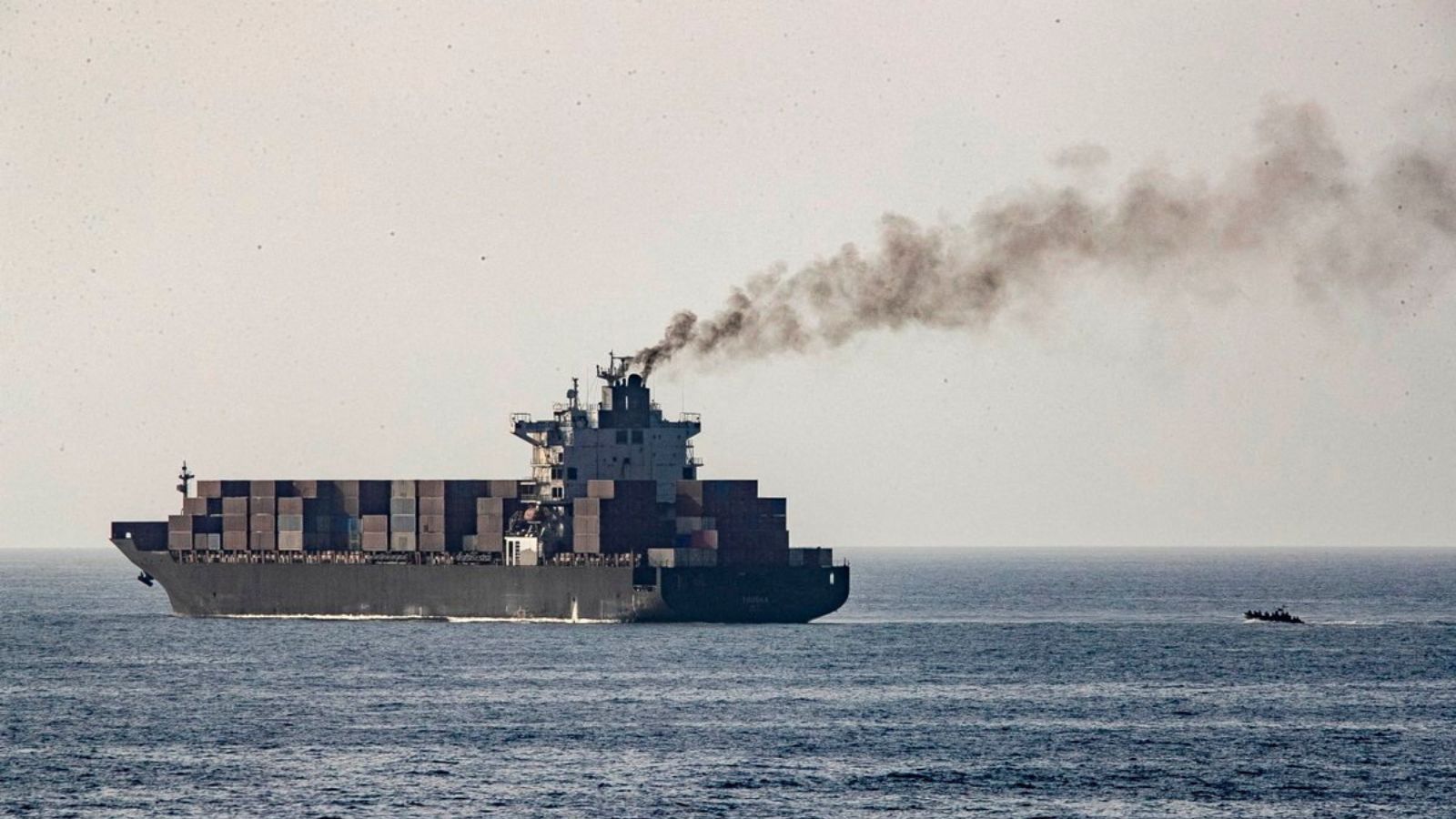
The United States Navy has moved from defensive posturing to active extraction in the Strait of Hormuz. Under the banner of Project Freedom, a massive coordinated effort is now underway to escort hundreds of commercial vessels trapped in what has effectively become a 21-mile-wide minefield. This isn't just about clearing a traffic jam. It is a desperate bid to prevent a global energy cardiac arrest. The Strait of Hormuz carries roughly 20% of the world’s petroleum and nearly a third of its liquefied natural gas. With Iranian-placed mines now littering the seabed and surface, the price of crude is no longer determined by supply and demand, but by the sheer bravery of tugboat captains and the precision of underwater drones.
For decades, the threat of closing the Strait was a rhetorical weapon. Now, it is a physical reality. The immediate mission involves specialized Mine Countermeasures (MCM) ships and Seahawk helicopters equipped with laser-based detection systems. They are working to carve out "safe corridors" for tankers that have been idling for weeks, their hulls gathering barnacles while their insurance premiums skyrocket to levels that threaten the solvency of mid-sized shipping firms.
The Mechanics of a Maritime Siege
To understand why this rescue is so difficult, you have to look at the geography of the Persian Gulf. The shipping lanes are narrow. They are predictable. This predictability makes them an easy target for "asymmetric" mining—using cheap, old-fashioned contact mines alongside sophisticated "smart" mines that can distinguish between a small patrol boat and a massive Very Large Crude Carrier (VLCC).
The U.S. Navy isn't just dealing with floating spheres of TNT. Modern naval mines are often buried in the silt of the seafloor, triggered by the magnetic signature or the acoustic frequency of a specific ship type. Project Freedom relies heavily on the Mark 18 Mod 2 Kingfish, an underwater drone that maps the sea floor with high-resolution sonar. When a mine is identified, it is either neutralized in place or towed to deeper water for a controlled detonation.
The bottleneck isn't just the mines. It's the "ghost fleet" of tankers that lack the sophisticated communications gear to coordinate with a military escort. Many of these ships are registered in "flag of convenience" nations like Panama or Liberia, manned by crews who are understandably terrified of being the first to find a gap in the Navy's sweep.
Why the Market is Panicking Despite the Escorts
Wall Street and the oil hubs in Singapore aren't breathing easy yet. Even if Project Freedom successfully extracts every ship currently in the Strait, the long-term math is grim. The cost of shipping a single barrel of oil through the Gulf has tripled in a month. This isn't just "war risk" surcharges; it’s the reality of a broken logistics chain.
The Insurance Deadlock
Most maritime insurance is handled by P&I Clubs (Protection and Indemnity). These organizations are currently reassessing the entire Gulf as a "total loss zone." If a ship hits a mine, the environmental cleanup alone could cost billions. Lloyd’s of London has signaled that without a permanent, 24/7 military presence in every square mile of the shipping channel, they may stop covering transit through Hormuz entirely.
If the ships aren't insured, they don't sail. If they don't sail, the refineries in Japan, India, and South Korea run dry. We are looking at a potential "supply shock" that could dwarf the 1973 oil crisis, not because the oil isn't there, but because the "pipe" is blocked by a few thousand dollars worth of Soviet-era explosives.
The Technology of Modern Mine Sweeping
Traditional minesweeping involved wooden-hulled ships that wouldn't trigger magnetic sensors. Today, the Navy uses a mix of "influence" and "mechanical" sweeping. Mechanical sweeping is the old-school method: cutting the cables of moored mines so they surface. Influence sweeping is more like a magic trick. The Navy uses ships or drones to emit signals that trick the mine into thinking a massive tanker is passing overhead.
The problem with Project Freedom is the sheer volume of the area. You can't just "mop" the ocean. It’s a three-dimensional chess game where the pieces are hidden under 200 feet of water. The Navy is currently utilizing the AN/AQS-20C, a towed sonar sensor that can detect and classify mines in a single pass. But even with this tech, the process is agonizingly slow. A single missed mine means a dead crew and a massive ecological disaster in one of the world's most sensitive marine environments.
The Geopolitical Gamble
There is a significant school of thought among naval analysts that Project Freedom is a trap. By committing such a massive portion of the Fifth Fleet to escort duty, the U.S. is leaving other areas of the Gulf vulnerable to fast-attack craft or shore-based missile batteries. Iran knows this. They don't need to win a naval battle; they just need to make the cost of "freedom" too high for the American taxpayer and the global economy to bear.
Some critics argue that the U.S. should be targeting the source of the mines—the storage facilities and the minelaying ships—rather than just cleaning up the mess. But that would mean a full-scale war. For now, the administration is betting on the "escort and extract" model, hoping that by safely guiding these ships out, they can lower the temperature of the crisis.
The Logistics of the Extraction
The operation is organized into "convoy blocks." Each block consists of roughly 10 to 15 tankers, led by an Arleigh Burke-class destroyer and flanked by littoral combat ships. These ships use their Aegis Combat Systems to provide a "bubble" of protection against aerial and surface threats, while the smaller MCM vessels lead the way, literally clearing a path through the water.
- Step 1: Identification. Drones map the "safe path" through the current mine clusters.
- Step 2: Verification. Divers or ROVs (Remotely Operated Vehicles) confirm the area is clear of "stealth" mines.
- Step 3: Transit. The tankers move in a single-file line at a steady 10 knots. Speed is the enemy of safety here; a fast-moving hull creates more displacement and a larger acoustic footprint.
- Step 4: Handoff. Once the ships clear the Strait and enter the Gulf of Oman, they are released to proceed to their destinations.
The Human Cost on the Decks
We talk about "ships" and "tonnage," but there are thousands of sailors trapped on these vessels. Many have been at sea for months. They are running low on fresh water, food, and, more importantly, morale. These aren't combatants. They are merchant mariners who signed up to move cargo, not to be human shields in a shadow war.
Reports from the interior of the Strait describe a "parking lot of giants." Massive ships, some over 1,000 feet long, are sitting motionless in the heat. The temperature on the steel decks can reach 140 degrees Fahrenheit. The psychological strain of knowing that a single "click" beneath the hull could end everything is immense.
The Shadow of the 1980s Tanker War
This isn't the first time the U.S. has had to do this. During the Iran-Iraq War in the late 80s, the Navy launched Operation Earnest Will. Back then, they reflagged Kuwaiti tankers as American ships to justify the escorts. The difference today is the technology. In the 80s, the mines were simple. Today, they are "cyber-enabled." Some analysts fear that certain mines could be activated remotely via satellite or low-frequency radio, meaning a "clear" path could become deadly in a heartbeat.
Furthermore, the global economy is far more fragile now than it was forty years ago. The "just-in-time" delivery system for everything from electronics to gasoline means that a two-week delay in the Strait causes ripples that are felt in gas stations in Ohio and factories in Germany within days.
The Role of Autonomous Systems
The real hero of Project Freedom isn't a person; it’s the algorithms. The Navy is using "swarms" of small, autonomous surface vessels (USVs) to act as decoys. These drones are designed to mimic the signature of a large ship. If a mine is going to go off, the Navy wants it to hit a $50,000 drone, not a $200 million tanker carrying $100 million in crude.
This is the first time autonomous systems have been used on this scale in a live combat-recovery environment. It’s a proving ground for the future of naval warfare. But machines fail. Sensors get clogged with salt and sand. In the end, it still comes down to the judgment of the commanders on the bridge.
The Fragility of the Corridor
Even with the Navy’s best efforts, the "safe corridor" is only as safe as the last sweep. The Strait is a dynamic environment. Tides shift. Silt moves. A mine that was buried six feet under might be exposed by the wake of a passing ship. Or worse, new mines could be dropped by dhows—small, inconspicuous wooden fishing boats—under the cover of night.
The U.S. has deployed massive surveillance blimps (aerostats) and high-altitude drones to monitor the surface, but the "dark" traffic of the Gulf is notoriously hard to track. A fisherman dropping a "package" overboard looks just like a fisherman dropping a net.
The Bottom Line for the Consumer
You might not care about maritime law or naval sonar, but you will care when the price of plastic, heating oil, and transportation spikes. If Project Freedom fails—if a major tanker is sunk in the channel—the Strait could be closed for months. The environmental impact would be a "black swan" event for the global ecosystem. A sunken VLCC in the middle of the shipping lane would be a physical barrier that no amount of minesweeping could fix. It would require one of the largest salvage operations in human history, all while under fire.
The Navy is currently operating on a 24-hour cycle. They are pushing their crews and their equipment to the limit. The goal is to get the "backlog" of ships out within the next ten days. After that, the question becomes: who is brave enough to send the next ship in?
The success of this mission won't be measured by how many ships it saves, but by whether it can restore enough confidence to keep the world's most important artery from hardening permanently.
Check the freight futures. If the rates start to dip, the Navy is winning. If they stay vertical, we are looking at a very cold, very expensive winter.