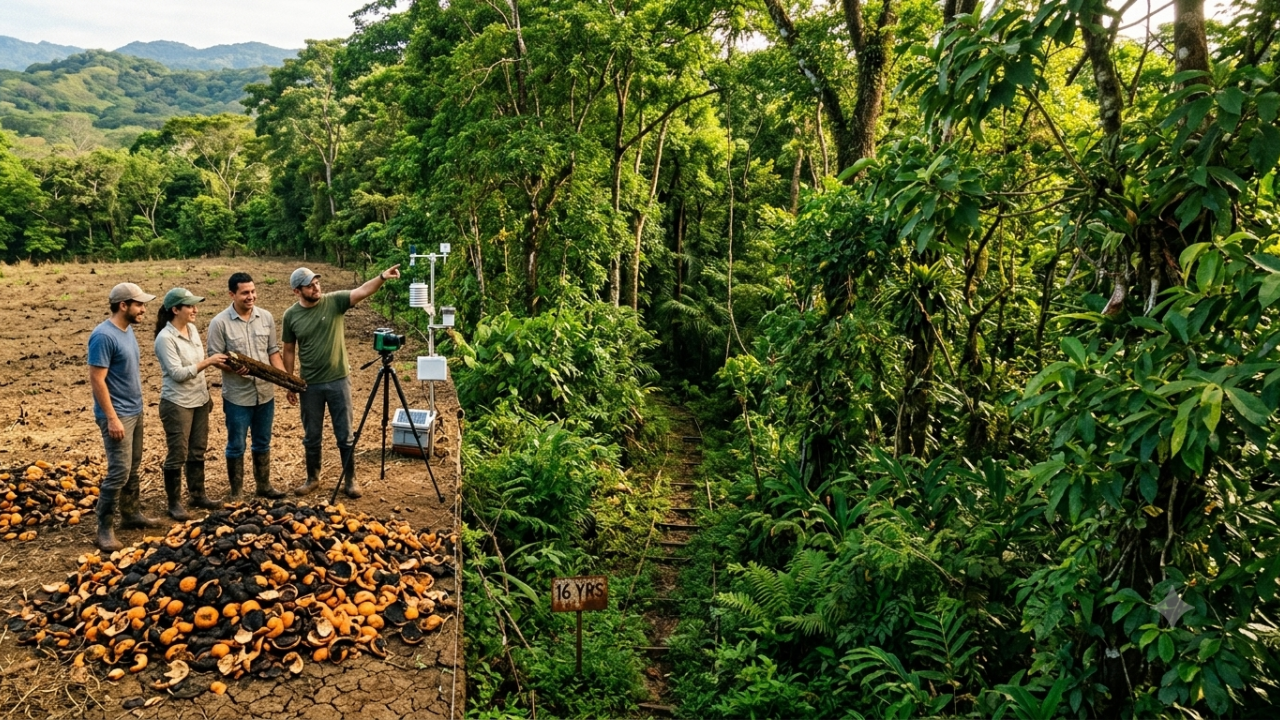
The Accidental Forest That Stunned Environmentalists
Waste is often viewed as the definitive endpoint of industrial efficiency. When a processing plant squeezes every drop of juice from a fruit, what remains is an enormous pile of wet peel, pulp, and seeds. Traditionally, this byproduct is hauled away at great expense, buried in landfills, or composted under heavily monitored conditions. In 1997, two ecologists approached this exact waste stream with a radically different thesis. They proposed dumping 12,000 metric tons of agricultural refuse directly onto a degraded, sterile cattle pasture in Costa Rica.
The immediate result looked less like a scientific experiment and more like an illegal dumping scheme. Tons of bright yellow citrus rinds buried an exhausted plot of land inside a protected national park, sparking swift legal action and accusations of corporate dumping from rival orange juice companies. Yet sixteen years later, when researchers finally returned to core soil samples and canopy measurements, they found something astonishing. The former wasteland had transformed into a lush, towering secondary forest. Tree species diversity had exploded, soil organic matter had doubled, and the invasive grasses that typically prevent reforestation had been choked out completely.
This unexpected outcome forces a hard look at how industrial byproducts interact with damaged ecosystems. Most environmental interventions rely on expensive, labor-intensive planting schedules and years of manual weeding. This accidental success story points toward a cheaper, faster mechanism. Agricultural refuse can act as a catalyst for environmental recovery. Understanding why this worked requires examining the intersection of soil microbiology, nutrient loading, and industrial ecology.
The Economics of Agricultural Waste Disposal
Industrial orange juice production generates millions of tons of unmarketable waste annually. Companies face a recurring operational headache. Hauling wet organic material to municipal dumps requires heavy diesel trucks, fuel, and tipping fees. For decades, the financial ledger treated this byproduct strictly as a liability.
In the late 1990s, a researcher named Daniel Janzen and his colleague Winnie Hallwachs struck a deal with Del Oro, a Costa Rican orange juice manufacturer. The company needed a cheap disposal method for its massive mountain of peels. The researchers needed a large-scale test for a simple theory. If you dump massive amounts of organic carbon onto nutrient-depleted soil, what happens to the native biology?
The agreement was straightforward. Del Oro dumped 300 truckloads of orange peel across a barren, overgrazed pasture previously stripped by cattle ranching. The land was dominated by Jaraguá, an invasive African grass brought over for cattle feed. This grass forms thick, dense mats that block native tree seeds from reaching the soil, effectively locking the ecosystem in a permanent state of degradation. Normal conservation methods require heavy machinery or chemical herbicides to clear the grass. The orange peel method bypassed all of that machinery through sheer biological weight.
+-------------------------------------------------------+
            THE DEGRADED PASTURE CYCLE
+-------------------------------------------------------+
[Overgrazed Soil] ---> [Invasive Jaraguá Grass Mats]
                             │
                             ▼
               [Native Seeds Blocked Out]
                             │
                             ▼
               [Permanent Ecological Stasis]
+-------------------------------------------------------+
When thousands of tons of wet citrus rinds blanketed the grass, two immediate things happened. First, the physical weight and lack of light smothered the invasive grass, killing it within months. Second, the rinds began to rot. As they decomposed, they released a concentrated flood of sugars, nitrogen, phosphorus, and potassium straight into the barren earth.
Inside the Rotting Mountain
Microorganisms drive the mechanics of ecological succession. When the orange peels arrived, local soil fungi and bacteria multiplied at an exponential rate. The sudden influx of carbon-rich and nutrient-dense material created a localized nutrient bomb.
Critics often assume that dumping rotting fruit creates a toxic wasteland of acid and mold. Oranges contain citric acid, which initially drops soil pH. However, as the aerobic and anaerobic breakdown processes take hold, the system neutralizes. More importantly, the decomposing mass attracts an army of detritivores. Dung beetles, ants, earthworms, and fruit flies arrived by the billions, churning the soil and aerating compacted layers that had been trodden flat by cattle for decades.
The Hidden Power of Citrus Oils
Beyond the basic nutrients, citrus peels contain high concentrations of essential oils, most notably d-limonene. Historically, industrial chemists worried that d-limonene would act as a natural pesticide, killing off beneficial soil microbes and halting biological activity.
Field observations disproved that theoretical concern. While d-limonene can inhibit certain bacteria in high concentrations, environmental exposure breaks the compound down rapidly under tropical sunlight. Instead of sterilizing the earth, the peeling process created a temporary biological bottleneck that favored fast-acting fungal networks. Mycorrhizal fungi, which form symbiotic relationships with tree roots, found an abundance of organic substrate to colonize.
The Comparative Reality of Modern Reforestation
To appreciate the scale of what happened in Costa Rica, we must contrast it with traditional ecological restoration projects. Standard reforestation typically involves nursery cultivation, seedling transport, manual hole-digging, staking, and years of watering and weeding.
| Metric | Traditional Reforestation | The Orange Peel Method |
|---|---|---|
| Primary Cost Driver | Labor, seedlings, irrigation | Transport, waste acquisition |
| Weed Control | Herbicides or manual clearing | Smothering via organic mass |
| Nutrient Delivery | Slow-release artificial fertilizers | Direct biological decomposition |
| Speed of Canopy Closure | Decades of managed growth | Rapid acceleration via soil priming |
The traditional model is capital-intensive and fragile. If funding dries up in year three, newly planted saplings often succumb to drought or invasive weeds. The Costa Rican experiment utilized a completely different vector. It aligned corporate waste management with public conservation goals. The company paid for transport, the land received free fertilizer and weed suppression, and nature did the heavy lifting without human intervention.
The Legal and Corporate Pushback
Not everyone celebrated the experiment when it began in 1997. A rival juice company, Tropicana, filed a lawsuit claiming that the project was polluting the national park and turning public land into a garbage dump.
The legal battle dragged on for years. Opponents pointed to the unsightly yellow sludge and the pungent smell of fermenting citrus as evidence of ecological harm. In 1999, the Costa Rican Supreme Court ruled against the project, forcing Del Oro to halt the dumping operations and removing the immediate supply of organic material.
For over a decade, that legal defeat looked like the end of the story. The land sat untouched, left to its own devices while the courts bickered over environmental definitions. But nature does not wait for bureaucratic clearance. While the lawyers argued, the initial application of 12,000 tons of waste had already triggered a cascade effect that could not be reversed.
Unlocking the Sixteen-Year Verdict
When scientists returned to the site years later, the visual transformation was striking. Researchers mapped two distinct study areas: the treated pasture that received the orange peels, and an adjacent control pasture that had been left untreated.
The differences defied easy explanation to anyone unfamiliar with soil science.
- Canopy Height: Trees in the treated area grew significantly taller, creating a closed canopy that blocked out direct sunlight and kept the ground moist.
- Soil Richness: Total carbon and nitrogen levels in the treated soil measured nearly double those of the control plot.
- Species Diversity: The treated zone hosted dozens of native tree species that had naturally migrated into the area via wind and animal droppings, compared to sparse, stunted vegetation in the control plot.
The orange peels did not just feed the soil; they fundamentally altered the physical structure of the earth. By breaking up the hardpan layer created by cattle hooves, water could finally infiltrate deep into the ground during rainy seasons. This subsurface moisture sustained the growing trees through dry spells, allowing them to outpace the surrounding grasslands permanently.
Scaling Up Industrial Bioremediation
The success in Costa Rica raises an obvious question. Why aren't we dumping food waste onto every degraded pasture on Earth?
The answer lies in logistics, chemistry, and municipal regulation. Not all agricultural waste streams are created equal. Citrus peels work well because they are thick, slow to rot compared to leafy vegetables, rich in specific carbon compounds, and generated in massive, localized quantities by juice factories. Applying unmonitored food waste to random plots of land can easily backfire. High nitrogen content without proper carbon balance leads to groundwater contamination through nitrate leaching. Rotting organic matter can also attract disease vectors, rats, and unmanaged insect swarms if not applied according to strict topographical and hydrological guidelines.
Furthermore, modern zoning laws rarely accommodate the deliberate application of industrial byproducts to conservation lands. Environmental protection agencies often classify food waste strictly as solid waste rather than a biological resource. Overcoming this regulatory hurdle requires shifting our legal frameworks to recognize that organic waste possesses transformative ecological value when managed correctly.
The Broader Implications for Industrial Waste
Our global economic system treats production and waste as two entirely separate entities. Raw materials enter the factory, products emerge, and waste is cast out into the shadows. The Costa Rican project demonstrates the viability of a circular industrial model where the end of one process becomes the absolute beginning of another.
We generate billions of tons of agricultural byproducts every year from coffee husks, rice hulls, sugarcane bagasse, and fruit processing plants. Most of this material is treated as a disposal problem requiring energy to destroy or relocate. If industries began viewing their organic waste streams as concentrated packages of soil nutrients, corporate balance sheets and global carbon budgets would shift dramatically.
The lesson from the pasture is not that we should haphazardly throw fruit peels across protected lands. It is that industrial operations and natural ecosystems are deeply compatible if we understand the underlying biological mechanics. By aligning waste reduction with ecological restoration, we bypass the immense costs of manual repair. The orange peel experiment proves that nature requires minimal assistance to heal deep wounds. It simply needs the right raw materials delivered to the right place, followed by the wisdom to step back and let the biology take over.